How accurate is a belt scale?
It is difficult to guarantee an exact margin of error for any application.
Our general guidelines are as follows:
Single Idler Scales: +/- 0.50 to 1.0% at 20 to 100 % of scale capacity
Example: +/- 200 to 400 lbs out of 40000 lb truckload
Dual Idler Scales: +/- 0.25 to .50% at 20 to 100 % of scale capacity
Example: +/- 100 to 200 lbs out of 40000 lb truckload
Many factors affect the performance of a belt scale.
- Slow-moving, heavily loaded belts are better than fast-moving, lightly loaded belts.
- The scale weighbridge should be protected from wind and rain if possible.
- The scale should not be near the head or tail end of the conveyor.
- Belt Tension should be properly adjusted.
What kind of applications can a belt scale be used in?
Product Inventory
Belt Scales can be more accurate than a volumetric stockpile measurement.
Contract Crushing / Recycling
Agree to use a belt scale to reduce conflict with crushing customers.
Production Efficiency
Increase production by monitoring feed rate to crushers, screens, returns, and waste.
Downtime Monitoring
Get a better idea of production lost to unscheduled downtime.
Truck / Railcar Loadout
Accurately load trucks the first time to reduce cycle times and maximize each load.
Avoid costly fines due to overloaded trucks.
Rate Control
Automatically control a feeder to maximize throughput.
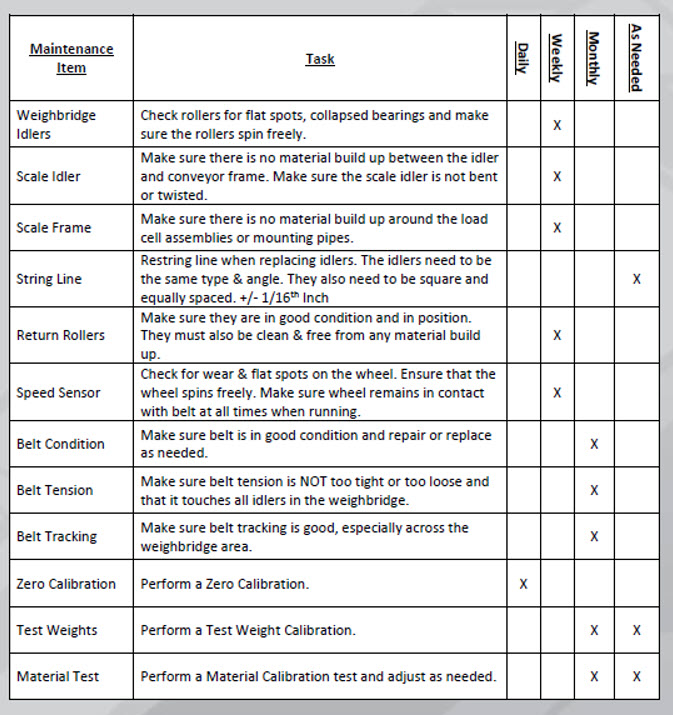
What kind of belt scale maintenance plan should I have?
The scale will only perform as well as the surrounding environment allows. Inspect the scale, belt, idlers, etc. on a regular basis to ensure all components are functioning properly.
Can I monitor my belt scale online?
Yes. You can monitor your production in near real-time using Plant Connect. Simply connect your Belt-Way Integrator to the internet. No onsite PC is required. Use our free mobile app or log on from your computer using a web browser like Google Chrome. Connect an unlimited number of scales.
Easily set up reports (CSV or PDF files) to email automatically.
Types of reports available:
Summary Reports
Detail Reports
Alarm Reports
Product Reports
Downtime Analysis Report
Loadout Report
Call Belt-Way or your local Regional Sales Manager for more information!
What information is needed to receive a quote for a belt scale?
Simply complete the quote form and return it to your local distributor. Pictures of the conveyor may be required.
What makes a belt scale accurate?
Proper installation and placement
Proper belt tension
Lower trough angles
Keep the belt clean
How often should I calibrate my scale using test weights or material tests?
This will depend on the application. It could be as little as once or twice a year or as often as every few days.
What is included with a complete belt scale?
A Belt-Way scale includes:
x1 – Belt-Way Integrator (equipped for AC or DC power)
x2 – Load Cell Assemblies
x2 – Mounting Pipes
x1 – Hardware Kit
x1 – Speed Sensor with Mounting Arm